
Fire Risk Assessments

Professional fire risk assessments for commercial and residential premises, carried out by qualified Fire Risk Assessors.
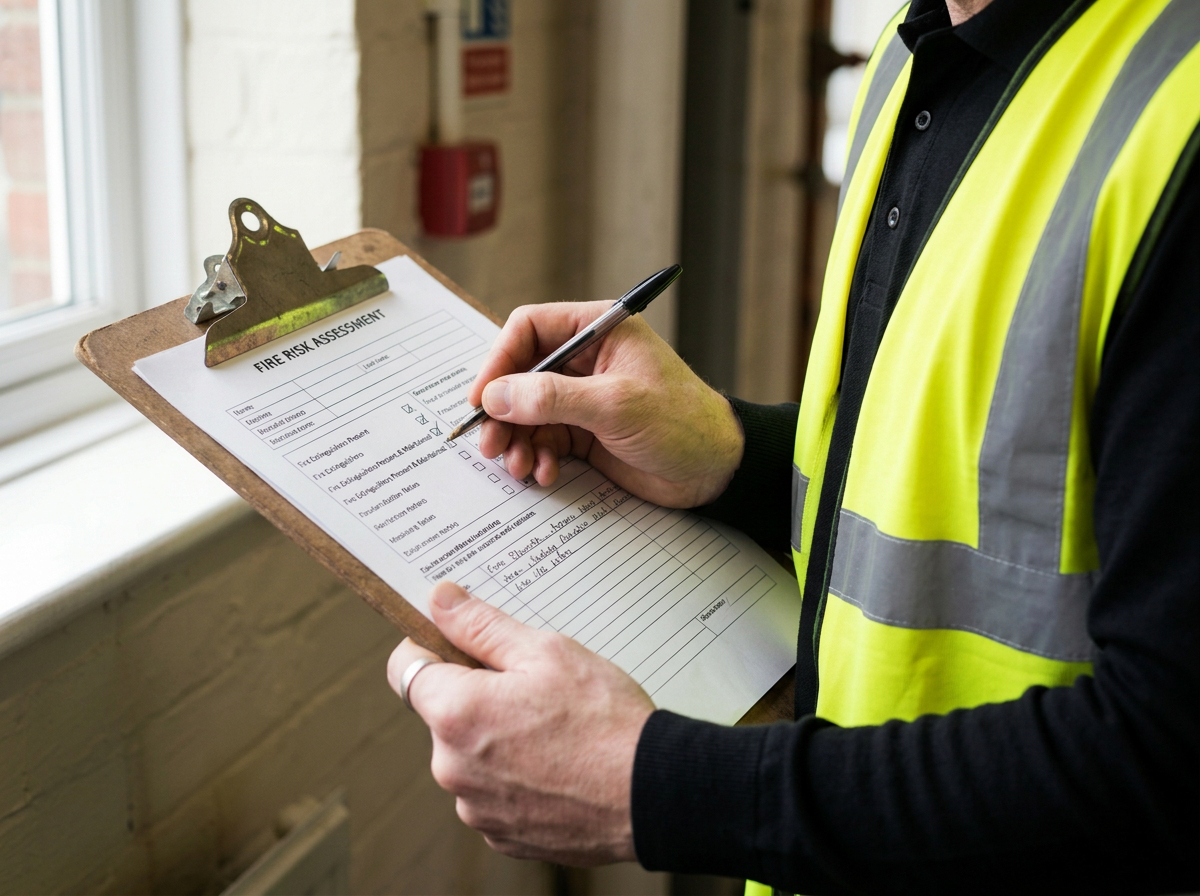
At Fire Guard Compliance Ltd, we provide professional fire risk assessment services for a wide range of commercial and residential premises, including offices, shops, warehouses, industrial units and residential blocks of flats.
A fire risk assessment is a fundamental part of effective fire safety management. For premises covered by the Regulatory Reform (Fire Safety) Order 2005, the Responsible Person must ensure that a suitable and sufficient fire risk assessment is carried out and kept under review.
The assessment should reflect the individual building, its use, occupancy and the fire safety measures provided. It should identify significant fire hazards, consider the people who may be at risk and assess whether existing fire safety arrangements are suitable.
Our fire risk assessments are carried out by qualified fire safety professionals. Our assessors hold a minimum Level 3 fire risk assessment qualification and are members of the Institute of Fire Safety Managers (IFSM).
We take a practical, risk-based approach to fire risk assessment. We don't rely on generic checklists; instead, we consider how the building is actually used and the specific risks present. Our reports provide clear findings and prioritised recommendations to help the Responsible Person understand what action may be required.
What Does a Fire Risk Assessment Cover?
-
Commercial Fire Risk Assessments
We provide commercial fire risk assessments for a wide range of business premises, including:
Offices
Shops and retail premises
Warehouses and industrial units
Workshops
Commercial buildings
Community premises
Other low to medium complexity premises
Our assessments are tailored to the individual premises and consider the specific risks associated with the building, its occupants and its use.
-
Residential Fire Risk Assessments
We also provide residential fire risk assessments, including assessments of blocks of flats and other residential premises where an assessment of the common parts and associated fire safety arrangements is required.
Particular attention is given to areas such as means of escape, fire doors, compartmentation, fire detection and alarm systems, smoke control, evacuation strategy and fire safety management.
Where an assessment identifies potential concerns with fire doors, compartmentation or fire-stopping, we can advise on whether further specialist inspection may be appropriate.
-
Our fire risk assessment reports are designed to be clear, practical and easy to understand.
We identify the significant findings from the assessment and provide prioritised recommendations to help the Responsible Person understand what needs to be addressed.
We provide independent fire safety assessment and inspection services and do not undertake remedial works ourselves. Where specialist remedial work or further investigation is required, we can help identify the appropriate next steps.
The exact scope of a fire risk assessment will depend on the type and complexity of the premises, but a typical assessment will consider:
Fire hazards – sources of ignition, combustible materials and potential causes of fire.
People at risk – employees, residents, visitors, customers and anyone who may require additional assistance.
Means of escape – escape routes, final exits and the adequacy of the available means of escape.
Fire doors and compartmentation – the condition and effectiveness of fire-resisting doors and fire separation where relevant.
Fire detection and warning – fire alarm systems, detection arrangements and methods of raising the alarm.
Emergency lighting – provision and suitability of emergency lighting.
Firefighting equipment – the provision, location and suitability of portable firefighting equipment.
Fire safety management – procedures, maintenance, training, emergency arrangements and other management controls.
The assessment considers whether the existing arrangements are appropriate and identifies any improvements required to reduce the risk from fire.
WHEN IS A FIRE RISK ASSESSMENT NEEDED?

A fire risk assessment is a legal requirement for all non-domestic premises and the common parts of residential buildings. The assessment should identify the fire hazards and risks within the premises, determine who may be at risk and establish the measures required to protect people from fire.
A fire risk assessment should be carried out when a premises first comes into use and should be reviewed regularly to ensure that it remains suitable and reflects the current use and condition of the building. The National Fire Chiefs Council (NFCC) recommends that fire risk assessments are reviewed at least annually, as well as whenever there is reason to suspect that the assessment is no longer valid or there has been a significant change in the matters to which it relates.
A new or updated fire risk assessment may also be necessary where there has been a significant change to the premises, such as:
Changes to the use or occupancy of the building
Alterations, refurbishment or changes to the layout
Changes to fire safety systems or measures
Changes in the number or vulnerability of occupants
The introduction of new processes, equipment or significant fire hazards
Following a fire, significant incident or other event that may affect fire safety
Where the existing fire risk assessment is no longer considered suitable or sufficient
For residential buildings, the scope and frequency of fire risk assessment will depend on the type of building and the areas being assessed. Fire risk assessments are particularly important in blocks of flats, houses in multiple occupation (HMOs), supported living accommodation and other multi-occupied residential premises, where the common areas and means of escape need to be considered.
At Fire Guard Compliance Ltd, we provide practical and proportionate fire risk assessments tailored to the individual premises, taking into account its use, occupants, layout and existing fire safety measures.
Not every building requires the same type of fire risk assessment. For residential buildings in particular, the appropriate assessment can depend on the building's construction, occupancy, evacuation strategy and the extent to which its fire-resisting construction can be assessed visually.
There are four commonly referenced types of fire risk assessment: Type 1, Type 2, Type 3 and Type 4. The main differences relate to the areas assessed and whether destructive or intrusive inspection is undertaken.
Types of Fire Risk Assessment
Type 1 – Common Parts (Non-Destructive)
A Type 1 Fire Risk Assessment is a non-destructive assessment focused primarily on the common parts of a residential building.
This typically includes communal entrances, corridors, lobbies, stairways, plant rooms and other areas forming part of the common escape routes.
The assessment considers the fire hazards and existing fire safety measures within these areas through visual inspection. It does not normally involve opening up walls, ceilings or other concealed construction.
Type 2 – Common Parts (Destructive)
A Type 2 Fire Risk Assessment follows the scope of a Type 1 assessment but includes destructive or intrusive inspection within the common parts of a residential building.
This typically covers communal entrances, corridors, lobbies, stairways, plant rooms and other areas forming part of the common escape routes.
The assessment involves opening up selected areas to inspect concealed fire-stopping, compartmentation and fire-resisting construction that cannot be assessed through visual inspection alone.
Type 3 – Dwellings & Common Parts (Non-Destructive)
A Type 3 Fire Risk Assessment extends the scope of a Type 1 assessment to include individual dwellings as well as the common parts.
This can be appropriate where conditions within individual flats are relevant to the building's overall fire safety strategy, or where there are concerns about alterations, fire separation or fire detection arrangements within dwellings.
Like a Type 1 assessment, a Type 3 assessment is generally non-destructive and relies primarily on visual inspection.
Type 4 – Dwellings & Common Parts (Destructive)
A Type 4 Fire Risk Assessment follows the scope of a Type 3 assessment but includes destructive or intrusive inspection within the dwellings and common parts of a residential building.
This typically covers individual flats as well as communal entrances, corridors, lobbies, stairways, plant rooms and other areas forming part of the common escape routes.
The assessment involves opening up selected areas to inspect concealed fire-stopping, compartmentation and fire-resisting construction that cannot be assessed through visual inspection alone.
The appropriate type of fire risk assessment depends on the individual building, its construction, use, occupancy and fire safety arrangements. If you're unsure which type of assessment is appropriate for your premises, we can discuss your requirements and help determine the most suitable scope before the assessment is arranged.
Need a Fire Risk Assessment for Your Premises?
At Fire Guard Compliance Ltd we provide independent fire risk assessments for commercial and residential premises across Greater Manchester and the wider North West. We assess the fire risks within your premises, consider the existing precautions and provide a clear report with prioritised findings and practical recommendations tailored to your building, its use and its occupants.
Whether you require a new assessment or a review of existing fire safety arrangements, we can help you understand your requirements and identify the appropriate next steps.